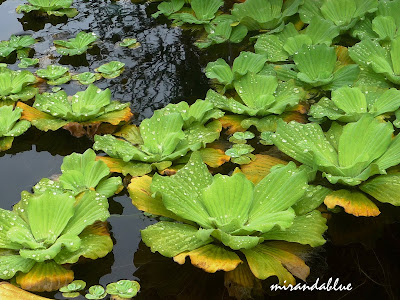
 Pistia stratiotes, commonly known as water lettuce or water cabbage, is a free-floating aquatic plant in tropical fresh waterways. This floating plant is a very aggressive invader and can cover entire surface of ponds, canals, lakes and rivers that can result to oxygen depletion and fish kills. They're beautiful but can have a severe impact on the environment and economy of infested areas. The dense mats created by connected rosettes block waterways, thus hindering flood control efforts. Water lettuce mats are also breeding place for mosquitoes.
Photos taken at Silangang Nayon, Pagbilao, Quezon


Hindi ito ang paborito kong sapatos ha? Naaliw lang ako sa pagkamalikhain ng Pinoy. Hulaan mo nga kung ano ang materyal ng sapatos na 'to? Sirit na...
Ito ay gawa sa tangkay ng water hyacinth, isang uri ng halaman na nabubuhay sa tubig-tabang; yong mga palutang-lutang d'yan sa Pasig River at Laguna de Bay. Halaman...baka kung ano ang iniisip mong lumulutang!
Mabilis pala dumami ang water hyacinth at nagiging problema sa maraming ilog, sapa at latian dahil sagabal ito sa daloy ng tubig, nagiging tirahan ng lamok, at nahaharang nito ang sikat ng araw na nagiging dahilan sa pagkamatay ng mga isda at iba pang halaman. Mabuti naman at may pakinabang rin pala ang water hyacinth. May nakita na akong mga baskets, placemats at trays na hinabi mula sa water hyacinth, pero di ko akalain na pwede rin pala itong gawing sapatos at tsinelas.
Gawa sa Liliw, Laguna ang mga tsinelas...magaan at maaliwalas sa paa ang mga ito, bagay na bagay ngayong panahon ng tag-init. Natanong ko sa nagbabantay ng booth kung pwede ang sapatos sa tag-ulan. Meron daw itong protective coating sa labas at may fabric liner naman sa loob kaya pwede raw itong isuot kahit tag-ulan. O di ba, kakaiba? Environmentally-friendly na sapatos at tsinelas! Ang tanong ay kung magsusuot ng ganitong sapatos ang mga Pinoy.  This is not a pair of my favorite shoes. I am just amazed at the Filipino innovative spirit. Guess what material was used on this pair of shoes. Make a wild guess...This pair of shoes is made from stalks of water hyacinth, an aquatic plant that grows on rivers, swamps, and lakes. You may have seen them free-floating at the Pasig River or Laguna de Bay. It's one of the fastest growing plants that is known to double its population in just two weeks. No wonder, water hyacinth has become a problem in some areas---they choke rivers and waterways. When uncontrolled, water hyacinth can cover lakes and ponds entirely; and this impacts water flow, blocks sunlight from reaching native aquatic plants, and starves the water of oxygen, often killing fish. This aquatic plant also create a prime habitat for mosquitoes.
 I am glad that innovative Filipinos have found something useful from this harmful plant. I have seen baskets, placemats and trays woven from water hyacinth but I didn't know they can also be made into shoes and slippers.The slippers are made from Liliw, Laguna, the tsinelas capital. They're lightweight and cool on the feet---perfect in this hellish weather. I asked the person who was manning the booth if the shoes can be used during rainy season. She explained that the material is coated to protect it from the elements, and the interior has a fabric liner. Great idea---environmentally-friendly shoes and slippers! The question is, do you think Filipino [men] would wear the water hyacinth shoes?
 :D

 I think it pisses God off if you walk by the color purple in a field somewhere and don't notice it.~ Alice Walker, from The Color Purple
Posted for Wordless Wednesday.
 From ancient times, the lotus has been a divine symbol in Asian traditions representing purity and beauty. The lotus flower grows in muddy water and rises above the surface to bloom with remarkable beauty. At night the flower closes and sinks underwater, at dawn it rises and opens again.


